
Ecommerce AI Visibility: Products, Categories, Entities and Citations
Ecommerce AI Visibility: how to optimize products, categories, entities and content to earn citations and visibility in generative AI search and shopping experiences.
ARTIFICIAL INTELLIGENCE
Video Guru
6/29/20266 min read
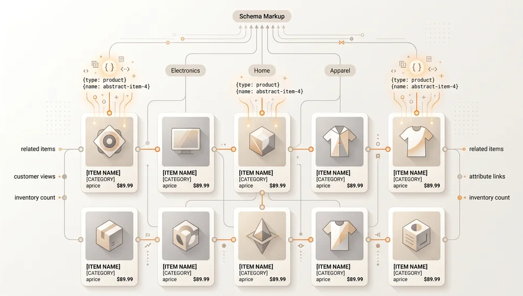
Ecommerce brands improve AI visibility by optimizing product detail pages with semantic richness, implementing Product schema, building category topical authority, managing product entity relationships, and earning citations through unique product content that AI systems cannot find elsewhere. Product pages with original descriptions, structured specifications, and connected category context outperform pages relying on manufacturer copy alone across both conventional search and emerging AI-driven recommendation surfaces.
Product Page Optimization for AI
AI search systems evaluate product pages differently than conventional keyword-based algorithms. Where traditional ranking factors prioritize exact-match terms and backlink profiles, AI retrieval models assess semantic completeness, factual specificity, and contextual relevance. Product pages that satisfy these criteria become eligible for citation in AI-generated responses and recommendation interfaces.
Why Manufacturer Descriptions Fail
Manufacturer-provided product descriptions create immediate problems for AI visibility. These descriptions appear identically across hundreds or thousands of retailer websites, giving AI systems no basis for distinguishing one seller from another. When Google's AI models or Bing's Copilot encounter the same text repeatedly, they treat it as generic reference material rather than citable source content. Original product descriptions that include usage contexts, material specifications, sizing guidance, and comparison data provide the semantic differentiation AI systems require for citation selection.
Semantic Coverage on Product Pages
Effective product pages for AI visibility cover multiple semantic dimensions. Specifications including dimensions, weight, materials, origin, and compatibility data create structured factual content. Usage contexts explaining when and why customers select the product help AI systems match items to searcher intent. Comparison data positioning the product against alternatives establishes relational knowledge that AI retrieval models use to answer comparative queries. Ingredient or component lists for relevant categories add granular factual content that supports precise AI responses.
Product pages for food items, for example, benefit from preparation suggestions, pairing recommendations, dietary classifications, and storage guidance. These content elements answer the kinds of practical questions AI systems routinely receive, increasing citation probability when users ask about specific products or product categories.
Review Integration and Aggregate Signals
Legitimate customer reviews contribute meaningfully to AI visibility when properly structured. Review text contains natural language descriptions of product performance, use cases, and customer satisfaction that AI systems process as additional semantic signals. Implementing Review schema alongside AggregateRating markup ensures these signals are machine-readable and associated with the correct product entities.
Product Schema Essentials
Structured data markup provides the machine-readable entity framework that connects product pages to AI understanding systems. Without schema, AI models must infer product attributes from unstructured text alone, a process that introduces ambiguity and reduces citation confidence. The following table presents a priority framework for ecommerce schema implementation based on AI system requirements and citation mechanics.
Schema Type
Priority
AI Function
Implementation Notes
Product
Critical
Core entity identification
Name, description, SKU, MPN required. Without Product schema, AI systems cannot reliably associate pages with product entities.
Offer
Critical
Price and availability context
Price, priceCurrency, availability, url. Enables AI systems to include current pricing in recommendations.
Review
High
Social proof and sentiment data
Legitimate reviews only. reviewBody text provides additional semantic signals for AI processing.
AggregateRating
High
Summary evaluation signal
ratingValue, reviewCount. Must correspond to actual visible reviews.
Brand
Medium
Brand entity association
Connects products to brand entities in Google's Knowledge Graph.
ImageObject
Medium
Visual entity reference
Descriptive file names and alt text support multimodal AI retrieval.
Organization
Medium
Seller verification
Name, url, logo. Establishes merchant credibility signals.
FAQPage
Supplemental
Question-answer extraction
Use sparingly and authentically. Avoid FAQ schema that does not reflect genuine customer questions.
Schema implementation should focus first on Product and Offer types, as these establish the fundamental entity relationship between a webpage and a commercial product. Review and AggregateRating markup follow, adding social proof signals that influence both AI citation selection and conventional search result presentation. Brand and Organization schema connect individual products to broader entity structures, enabling AI systems to reason about products within brand and merchant contexts.
Category Page Strategy
Category pages function as topical hubs that establish the semantic relationship between products and the broader contexts in which AI systems understand them. A well-structured category page does more than list products; it defines the topical boundaries, explains selection criteria, and creates the entity framework that connects individual items to category-level intent.
Categories as Topical Authority Hubs
AI systems process category pages as authoritative summaries of product domains. Category descriptions that explain what defines the category, how products differ within it, and what factors buyers should consider provide the explanatory content AI models cite when responding to broad product queries. A category page for Italian pasta that explains pasta shapes, regional origins, cooking times, and sauce pairings establishes topical authority that individual product pages alone cannot achieve.
Internal Linking Architecture
The linking structure between category pages and product pages signals entity relationships to AI systems. Category-to-product links establish parent-child relationships that help AI models understand product classification. Breadcrumb navigation with BreadcrumbList schema reinforces this hierarchy, enabling AI systems to trace product location within the catalogue structure. Cross-category linking between related categories strengthens topical connections and distributes semantic authority across the product catalogue.
Entity Relationships Between Categories, Brands, and Products
Modern AI search systems reason about entities and their relationships. Ecommerce sites that explicitly connect categories to brands and products through structured content help these systems build accurate knowledge graphs. Brand landing pages that list product categories, category pages that reference key brands, and product pages that specify both category and brand membership create the triple-relationship structure that AI systems use for reasoning and recommendation.
Client Evidence: Buono and Lampone
▶ Evidence
Buono.hu — Italian Food Ecommerce
Buono operates an online Italian food shop serving the Hungarian market. SEMrush-estimated data from early 2025 shows an AI Visibility score of 18, 25 AI mentions, and 76 cited pages. These metrics reflect how product-level semantic coverage translates into AI citation activity.
Individual product pages for items including pancetta, linguine, and passata demonstrated measurable traffic gains following content optimization focused on original descriptions, ingredient details, preparation guidance, and Italian origin context. Each product page addressed the specific semantic dimensions AI systems need to cite products in response to cooking-related queries.
Data source: SEMrush AI Visibility estimates. Traffic figures are estimates, not confirmed financial metrics.
The Buono case illustrates how specialized ecommerce sites with focused catalogues benefit from product-level content depth. Rather than competing on product range, the site established semantic authority for each product through detailed, original content that manufacturer descriptions could not provide. This approach aligns with how AI retrieval models select sources: they prioritize content that provides specific, verifiable information not readily available elsewhere.
▶ Evidence
Lampone.hu — Home Improvement Ecommerce
Lampone operates in the home and garden improvement sector with a broad product catalogue spanning multiple related categories. The site achieved 212 improving positions across connected intent clusters, demonstrating how catalogue breadth combined with category-level topical coverage builds visibility across related search domains.
Domain-level data showed traffic at -11% overall during the measurement period, a figure that underscores the distinction between AI visibility metrics and conventional traffic analytics. Improving positions in AI-driven search surfaces do not always correlate immediately with organic traffic changes, particularly during periods of search engine interface transition.
Data source: SEMrush position tracking estimates. Traffic figures are estimates, not confirmed financial metrics.
The Lampone case demonstrates a different pattern from Buono. Where Buono succeeded through deep product-level content in a narrow vertical, Lampone built visibility across a broader catalogue where category relationships and cross-category intent clusters drive AI citation potential. Both patterns are valid approaches depending on catalogue structure and market position.
▶ Key Insight
Key Insight
Detailed product-level semantic coverage supports both conventional search visibility and emerging AI citation coverage because it addresses the fundamental information need that all retrieval systems share: specific, verifiable, original content about entities that users query. Product pages containing unique specifications, usage contexts, and comparison data provide the factual substrate that AI models require to generate accurate responses about commercial products, regardless of the specific algorithm processing the query.
Ecommerce-Specific AI Visibility Metrics
Generic SEO metrics do not fully capture how AI systems interact with ecommerce catalogues. The following metrics provide more precise measurement of AI visibility for product-focused websites.
· Product citation rate: The percentage of product pages in the catalogue that receive at least one AI citation within a measurement period. This metric indicates how effectively product content meets AI system requirements for factual specificity.
· Category mention share: The frequency with which category pages appear in AI-generated responses for relevant commercial queries. This measures topical authority at the category level rather than individual product performance.
· Competitive product comparison visibility: How often the brand's products appear in AI-generated comparisons against competitor offerings. This metric reflects the strength of product entity relationships and comparison content.
· Schema coverage ratio: The percentage of product pages with complete Product, Offer, and Review schema markup. Incomplete schema reduces AI system confidence in product data.
· Product entity consistency: The alignment between schema-declared product attributes, page content, and category classification. Inconsistencies create entity confusion that reduces citation probability.
These metrics should be tracked alongside conventional organic traffic and ranking data. AI visibility often moves on different timelines than traditional SEO metrics, and improvements in citation rates may precede measurable traffic changes as search interfaces continue evolving.
Frequently Asked Questions
Sources
1. Google Developers. "AI Features in Search." https://developers.google.com/search/docs/appearance/ai-features. Accessed January 2025.
2. Bing Webmaster Blog. "Introducing AI Performance in Bing Webmaster Tools — Public Preview." https://blogs.bing.com/webmaster/February-2026/Introducing-AI-Performance-in-Bing-Webmaster-Tools-Public-Preview. Published February 2026.
3. Schema.org. "Product Schema Type." https://schema.org/Product.
4. SEMrush. "AI Visibility" tracking methodology. https://www.semrush.com/. Data used in Buono.hu and Lampone.hu case references.
Optimize Your Product Catalogue for AI Search
Product pages, category structures, and schema markup work together to determine whether AI systems cite and recommend your products. Review your ecommerce AI visibility strategy to identify where product-level content improvements and structured data enhancements can increase citation coverage across AI search platforms.