
From Demo to Deployment: Closing the Chasm Between AI Prototypes and Production Systems
From Demo to Deployment: how to close the chasm between AI prototypes and production systems with practical strategies for scalable, reliable, and business-aligned AI implementations.
ARTIFICIAL INTELLIGENCE
Video Guru
7/10/20262 min read
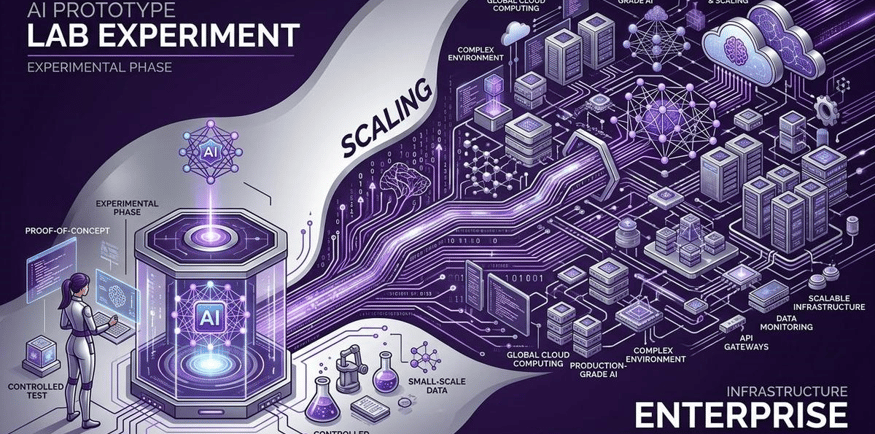
The gap between functional AI prototype and reliable production system has claimed more technology initiatives than perhaps any other challenge in modern software development. Marketing leaders, dazzled by compelling demonstrations and pressured by competitive dynamics, frequently authorize AI investments based on prototype performance that bears little relationship to operational reality. The result is a graveyard of stalled initiatives—sentiment analysis that fails on real customer language, recommendation engines that produce embarrassing suggestions at scale, chatbots that degrade from helpful to harmful when exposed to genuine user behavior.
The prototype-to-production chasm manifests across multiple technical dimensions. Data pipelines that handle sanitized prototype datasets collapse under the volume, velocity, and variety of production data. Models trained on carefully curated inputs exhibit unpredictable behavior when exposed to the full spectrum of real-world inputs, edge cases, and adversarial manipulation. Infrastructure provisioned for demonstration purposes lacks the scalability, resilience, and monitoring capabilities that continuous operation demands.
The organizational dimension compounds technical challenges. Prototype development typically engages small, skilled teams with deep contextual understanding. Production deployment requires coordination across engineering, operations, security, compliance, and support functions—each with legitimate concerns that prototype teams rarely encounter. The cultural shift from experimentation mindset to operational discipline encounters resistance, particularly when marketing timelines have been committed based on prototype demonstrations.
Responsible AI deployment requires structured progression through defined maturity stages. Proof-of-concept validates technical feasibility with controlled data and limited scope. Pilot deployment tests operational integration with real users in constrained environments. Staged rollout progressively expands exposure while monitoring for performance degradation, unexpected behavior, and user experience issues. Full production deployment, when finally authorized, includes comprehensive observability, rollback procedures, and incident response protocols.
The measurement framework must evolve across these stages. Prototypes are evaluated on accuracy metrics against benchmark datasets. Production systems require monitoring business outcome metrics, operational reliability indicators, fairness and bias assessments, and user experience quality measures. The metrics that matter for production bear little resemblance to the metrics that justified initial investment.
E-commerce and digital platform implementations illustrate these challenges concretely. An AI-powered product recommendation prototype might demonstrate impressive click-through rates in controlled testing, yet fail catastrophically when deployed across diverse product catalogs, seasonal inventory fluctuations, and regional customer preference variations. Practical guidance on production system optimization, such as insights from analysis exploring https://konyvajanlo101.blog.hu/2026/06/29/austrian_e-commerce_product_page_seo_why_standard_tactics_fall_short, demonstrates how standardized approaches often fail when confronted with operational complexity that prototypes mask.
Organizations mastering the prototype-to-production transition invest heavily in MLOps infrastructure, cross-functional deployment governance, and realistic timeline setting that accounts for the inevitable friction of operationalizing intelligent systems. They build explicit risk mitigation into deployment plans, including model rollback triggers, human-in-the-loop escalation paths, and graceful degradation mechanisms when AI systems encounter situations beyond their competence boundaries.
The human capital dimension deserves particular attention. Teams skilled at prototype development rarely possess the operational expertise required for production systems, and vice versa. Successful transitions require deliberate knowledge transfer, cross-training investments, and often strategic hiring to fill operational gaps. Organizations that attempt production deployment with exclusively prototype-skilled teams court the specific failure modes that have undermined countless AI initiatives.
Key Takeaways: - The gap between AI prototype and production system spans technical, organizational, and measurement dimensions that frequently derail initiatives - Structured progression through defined maturity stages—from proof-of-concept to staged rollout—reduces production deployment risk - Production measurement frameworks must evolve beyond prototype accuracy metrics to include business outcomes, reliability, fairness, and user experience indicators
Resources: - https://konyvajanlo101.blog.hu/2026/06/29/austrian_e-commerce_product_page_seo_why_standard_tactics_fall_short