
Lampone.hu Case Study: Building a Terrace and Home-Improvement Topic Cluster
Lampone.hu Case Study: how building a strong terrace and home-improvement topic cluster significantly boosted organic visibility, traffic, and authority.
ARTIFICIAL INTELLIGENCE
Video Guru
6/29/202611 min read
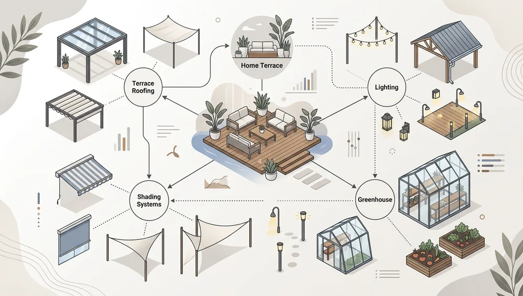
Summary: Lampone.hu built search visibility across connected terrace and home-improvement intent clusters through topic cluster architecture. According to SEMrush data from 27 June 2026, the domain recorded 212 improved positions and ranking gains for "terasztető" (position 12 to 5) and "teraszfedés" (position 6 to 3), while entering tracked visibility for 13 shading, paint and lighting queries. Domain-level organic traffic estimates declined 11%, illustrating that page-level gains and broader domain trends can diverge.
Business Context and Challenge
Lampone.hu operates in the Hungarian home-improvement retail sector with a catalogue spanning terrace roofing, shading, paint, lighting and greenhouse products. The challenge is characteristic of broad-catalogue retailers: each product category serves distinct intent, yet these intents are connected in the customer's home-improvement journey. A homeowner researching terrace roofing may subsequently need shading, lighting and paint. The question is how to build visibility across connected clusters without fragmenting authority.
SEMrush Data Overview
According to the supplied SEMrush snapshot dated 27 June 2026, Lampone.hu displayed the following domain-level metrics:
Metric
Value
Authority Score
23
Organic Traffic (estimate)
4,500 (−11%)
Organic Keywords
~1,100 (−1.5%)
Referring Domains
303
Backlinks
~418,000
AI Visibility Score
14
AI Mentions
1
AI-Cited Pages
1
Improved Positions
212
Declined Positions
102
SERP Changes
164
The SEMrush report recorded 212 improved positions against 102 declined — a net positive of 110. However, domain-level organic traffic was estimated at 4,500, down 11%, and tracked keywords fell approximately 1.5%. Position improvements in specific clusters do not automatically produce aggregate traffic growth when broader domain trends exert downward pressure.
Page-Level Ranking Movements
Specific keywords demonstrated clear upward movement:
Keyword
Previous
Current
Movement
terasztető
12
5
+7
teraszfedés
6
3
+3
szekreter
Not tracked
9
New entry
"Terasztető" moved from position 12 to 5 — a first-page result for a competitive Hungarian term. "Teraszfedés" strengthened from 6 to 3. "Szekreter" entered the tracked set at position 9, showing visibility expansion into adjacent furniture queries.
New Tracked Visibility Entries
The SEMrush snapshot identified 13 newly tracked keywords across multiple product categories:
· Terrace and shading: "terasz árnyékolás", "árnyékoló teraszra", "pergola terasz", "terasz árnyékoló roló", "panel erkély árnyékolás"
· Roofing and structure: "polikarbonát előtető", "előtető", "fémvázas előtető"
· Paint and colour: "héra falfesték színek", "beltéri falfesték színek"
· Lighting and garden: "terasz világítás", "melegház", "fa lámpás"
This distribution spans four distinct product domains, suggesting visibility gains emerged across connected categories rather than a single silo.
Topic Cluster Content Architecture
The Lampone.hu site organizes products by use case — terrace, garden, interior — rather than by manufacturer or SKU. Within the terrace cluster, roofing, shading and lighting connect as related sub-topics. The paint cluster links interior and exterior colour selections. The garden cluster connects greenhouse equipment with lighting.
This architecture creates internal linking paths between related categories, allowing relevance signals to flow across clusters. It also aligns site structure with the customer journey, where homeowners plan projects holistically.
▶ Evidence
Cluster Architecture Framework
Broad-catalogue retailers can apply a three-layer topic cluster model:
· Primary cluster: A high-intent use-case category (e.g., terrace improvement)
· Sub-clusters: Product categories within that use case (roofing, shading, lighting)
· Connection layer: Cross-links between sub-clusters reflecting project-based customer journeys
The connection layer is the differentiator. Without it, sub-clusters remain isolated silos competing independently.
Page-Level Gains vs. Domain Trends
The divergence between page-level improvements and domain-level trends requires careful interpretation. Third-party tools model traffic from rankings and estimated volumes — they do not measure actual server traffic. A domain may gain first-page positions while losing rankings for higher-volume keywords elsewhere. SERP feature changes and seasonal fluctuations also influence aggregate estimates.
▶ Key Insight
Page-level ranking improvements and domain-level traffic estimates frequently diverge in broad-catalogue sites because third-party SEO tools model aggregate traffic from individual position estimates. A site can gain seven positions for a valuable keyword while losing visibility for higher-volume terms elsewhere, producing net position gains alongside weaker traffic signals. This pattern reflects the distributed nature of search visibility across large sites.
The SEMrush snapshot also recorded an AI Visibility Score of 14 with 1 AI mention and 1 AI-cited page — early-stage metrics consistent with a specialized retail domain building traditional visibility first. The structured visibility approach connecting topic clusters with entity signals can bridge this gap over time.
▶ Direct Answer
All data is drawn from a supplied SEMrush snapshot dated 27 June 2026. SEMrush provides third-party estimates based on ranking databases and traffic modelling. These figures do not represent first-party analytics. Authority Score, traffic estimates and keyword counts are directional indicators. Ranking positions reflect SEMrush's tracking and may vary from actual Google rankings by location or account state. No causation between content architecture changes and ranking movements has been established.
Transferable Lessons for Broad-Catalogue Sites
The Lampone case demonstrates how a broad home, garden and terrace catalogue can build visibility across connected intent clusters. Four lessons apply:
1. Organize by Use Case
Taxonomies built around customer projects — "terrace improvement" rather than "aluminium products" — align information architecture with search intent. This makes internal linking intuitive and helps search systems understand topical relationships.
2. Expect Mixed Domain Signals
Large sites show mixed domain metrics as individual clusters gain while others decline. Evaluating performance requires cluster-level analysis, not just aggregates. The 212 improvements against 102 declines illustrate this pattern.
3. Track New Keyword Entries
New keyword entries are leading indicators of expanding topical coverage. They often precede traffic growth because they represent previously untracked rankings. Monitoring entries provides earlier performance signals than traffic alone.
4. Connect Adjacent Clusters
Cross-links between sub-clusters — terrace roofing to terrace lighting — are where topical authority compounds. Without connections, well-developed sub-clusters remain isolated. With them, the site builds cumulative relevance across a broader intent map.
Frequently Asked Questions
Sources
1. SEMrush domain overview snapshot for lampone.hu, dated 27 June 2026. Third-party estimated data including Authority Score, organic traffic, organic keywords, referring domains, backlinks, AI Visibility Score, position tracking and SERP changes.
2. Lampone.hu — Hungarian home, garden and terrace improvement retailer. Client domain examined in this case study.
3. Roth AI Consulting Case Studies — Hub of AI visibility and search performance case studies including Hungarian and international clients.
Review additional case studies or discuss a visibility project for your business.
Reading time: approximately 9 minutes
Article 22: What Lampone's Ranking Gains Teach About Page-Level and Domain-Level SEO Data
Page-level ranking movements and domain-level traffic rarely move in lockstep. Understanding why separates honest SEO reporting from misleading dashboards.
Page-level ranking gains can coexist with domain-wide traffic declines because different metrics measure different things. Page-level data tracks individual URL performance for specific keywords, while domain-level estimates aggregate traffic across all pages and search terms. When 212 positions improved for lampone.hu but estimated organic traffic fell 11%, the divergence exposed seasonal patterns, competitor gains on untracked keywords, and SERP feature changes affecting headline numbers — not a failing SEO strategy.
The Paradox: 212 Improved Positions, -11% Traffic
In late 2024, lampone.hu — a Hungarian outdoor living and home furnishing business — presented a data puzzle that frustrates every SEO professional who has ever faced a skeptical client. The numbers:
· 212 keywords moved to better positions
· 13 new terms gained measurable visibility
· "terasztető" climbed from position 12 to 5
· "teraszfedés" advanced from position 6 to 3
· "szekreter" entered the tracked set at position 9
And yet:
· -11% estimated organic traffic
· -1.5% organic keywords
At first glance, these figures contradict each other. A marketing director scanning a monthly report might conclude the SEO campaign failed. A deeper reading tells a different story — one about the fundamental disconnect between page-level ranking data and domain-level traffic estimates.
This article uses Lampone's SEMrush data as a teaching case to explain why these metrics diverge, how to interpret both honestly, and what the numbers actually reveal about a campaign's trajectory.
Page-Level vs. Domain-Level Metrics: How SEMrush Calculates Each
SEMrush and similar platforms collect ranking data by querying Google's search results for tracked keywords and recording where specific URLs appear. This process sounds straightforward, but it produces two fundamentally different data products that are too often conflated.
How Page-Level Rankings Are Measured
Page-level data answers the question: "Where does this specific URL rank for this specific keyword today?" SEMrush queries Google from its data centers, records the position of the target URL, and stores that snapshot. When a page moves from position 12 to 5 for "terasztető," that is a verified positional change recorded in the database.
The 212 "improved positions" for lampone.hu represent instances where a tracked keyword's ranking was better in the current period than in the prior period. The 102 "declined positions" represent the opposite. These are discrete, countable events — a page moved up or it moved down.
How Domain-Level Traffic Is Estimated
Domain-level traffic is an entirely different calculation. SEMrush does not have access to a website's server logs or Google Analytics. Instead, it estimates total organic traffic by combining two inputs: (1) the positions it observes for all tracked keywords, and (2) estimated click-through rates (CTRs) for each position, multiplied by estimated monthly search volume.
This estimation model introduces multiple layers of uncertainty:
Factor
Impact on Estimate
Search volume estimates
Based on historical averages; real monthly volume fluctuates with seasonality and trends
CTR curves
Generic industry averages; actual CTR varies by SERP features, brand recognition, and intent type
SERP feature changes
Featured snippets, local packs, or video carousels can shift real clicks without changing position numbers
Not-provided keywords
SEMrush tracks a subset of keywords; untracked terms can represent significant traffic
The critical distinction: page-level rankings measure position changes for known keywords. Domain-level traffic estimates model total clicks from assumptions. They are related but not equivalent.
Why Domain Traffic Declined
With 212 improving positions, why did the -11% traffic estimate land in the report header? Several factors likely contributed. Understanding them is essential for honest reporting.
Seasonal Demand Patterns
Lampone operates in the outdoor living sector — pergolas, terrace roofing, greenhouse structures. Search demand for these products peaks in spring and early summer when homeowners plan outdoor projects. A measurement period capturing late autumn or winter months would naturally show lower estimated search volumes even with identical rankings. The CTR estimates SEMrush applies assume steady search volume, so seasonal contraction alone can depress headline traffic figures.
Competitor Gains on Untracked Keywords
SEMrush tracks roughly 1,100 organic keywords for lampone.hu. Google's index, however, associates the domain with far more search terms. A competitor gaining ground on keywords outside the tracked set — long-tail variants, emerging product categories, or informational queries — would not appear in the "declined positions" count but would reduce overall traffic estimates.
SERP Feature Redistribution
Between measurement periods, Google may have introduced or expanded featured snippets, image carousels, or local pack results for queries where lampone.hu previously held standard blue-link positions. A position 3 organic result beneath a featured snippet receives fewer clicks than a position 3 result without one. The position number remains the same; the traffic does not.
Macro Search Behavior Shifts
Broader economic conditions affect search behavior in the home improvement sector. Higher interest rates or currency fluctuations in the Hungarian market may reduce total search volume for discretionary outdoor projects. When the total search pie shrinks, every participant's slice shrinks with it — even those gaining share.
Why Page-Level Rankings Improved
The page-level gains were not random fluctuation. They reflected deliberate optimization work producing measurable results for specific content assets.
Content Optimization for Commercial Intent Terms
The climb of "terasztető" from position 12 to 5 and "teraszfedés" from position 6 to 3 both represent high-value commercial keywords moving into the first-page visibility zone where meaningful click volume begins. A move from page two to page one typically produces more traffic impact than a move within page one, making the terasztető improvement particularly significant. The "szekreter" entry at position 9 established visibility for an additional product category.
Topic Cluster Effects
The 13 new tracked terms — including "terasz árnyékolás" (terrace shading), "pergola terasz" (pergola terrace), and "melegház" (greenhouse) — suggest that content organized around thematic clusters began earning visibility. When supporting pages for related subtopics gain traction, they reinforce the topical authority of pillar pages targeting head terms. This is the mechanism by which topic clusters compound ranking improvements over time.
Internal Linking Improvements
Internal link structure changes often precede broad ranking improvements across a cluster. Redirecting link equity from established pages to newer or previously underlinked commercial pages can lift rankings for multiple terms simultaneously, which matches the pattern of 212 improving positions distributed across the site rather than concentrated on a single page.
How to Read SEO Reports Honestly: A 6-Point Framework
Most SEO reporting failures stem from presenting a single number as the whole story. The following framework, developed from cases like Lampone's, provides a structured method for distinguishing genuine progress from statistical noise.
Step
Question to Ask
What to Check
Red Flag Indicators
1
What exactly changed?
Separate position changes, traffic estimates, and keyword counts. Each measures a different dimension.
Report merges all metrics into a single "SEO performance" score without showing components.
2
Which keywords moved?
Identify whether improved positions are for high-volume commercial terms or low-volume informational queries.
Position gains are concentrated on branded terms or keywords with negligible search volume.
3
Where did they move from and to?
A 12→5 move is vastly more impactful than a 45→38 move. Crossing onto page one is the critical threshold.
Report presents raw "improved position count" without stratifying by starting position or page.
4
What is the comparison period?
Year-over-year comparisons eliminate seasonality. Month-to-month comparisons amplify noise.
Reporting compares October to September for a seasonal business without acknowledging seasonality.
5
What happened to SERP features?
Check whether featured snippets, local packs, or other features appeared for key terms between periods.
Traffic declined despite stable positions, but no analysis of SERP feature changes is provided.
6
What do first-party sources show?
Cross-reference third-party estimates with Google Search Console impressions and click data.
Report relies exclusively on third-party estimates without validating against Search Console.
This framework applies to any SEO reporting scenario where third-party dashboards produce conflicting signals. The goal is not to dismiss negative traffic indicators but to understand what they actually represent before drawing strategic conclusions.
▶ Key Insight
Honest SEO reporting requires treating page-level ranking improvements and domain-level traffic estimates as separate signals that answer different questions. Ranking data measures whether specific content assets are gaining relevance authority for targeted queries. Traffic estimates model aggregate click volume subject to seasonal, competitive, and algorithmic variables beyond any single site's control. Conflating the two produces either false optimism or false despair — neither serves strategic decision-making.
The Lampone Data as Teaching Example
Walking through Lampone's specific numbers illustrates how the framework operates in practice.
▶ Evidence
Lampone.hu Data Snapshot (SEMrush)
· Authority Score: 23
· Organic Traffic (estimate): 4,500 (-11%)
· Organic Keywords: ~1,100 (-1.5%)
· Improved Positions: 212
· Declined Positions: 102
· SERP Changes: 164
Key Ranking Movements:
· "terasztető": position 12 → position 5
· "teraszfedés": position 6 → position 3
· "szekreter": new entry at position 9
· 13 new terms with tracked visibility including "terasz árnyékolás," "pergola terasz," "melegház"
Applying the Framework
Step 1 — Separate the metrics: 212 improving positions, 102 declining positions, and a net -11% traffic estimate are distinct measurements. The improving-to-declining ratio of roughly 2:1 is favorable on its own terms.
Step 2 — Identify which keywords moved: The improvements concentrated on commercial-intent product terms (terrace roofing, pergolas, greenhouses, secretary desks) — not branded or navigational queries. These are precisely the keywords that drive revenue.
Step 3 — Assess position trajectory: The terasztető move from 12 to 5 crosses the critical page-one boundary. The teraszfedés move from 6 to 3 places the page in the high-CTR zone. The szekreter entry at position 9 establishes first-page presence for a new product line.
Step 4 — Consider seasonality: Outdoor living products in the Hungarian market follow strong seasonal patterns. If the measurement captured a low-demand period, traffic estimates would contract even with maintained or improved rankings.
Step 5 — Account for SERP changes: The 164 recorded SERP changes indicate that Google modified result page composition for numerous tracked queries during the period. Any featured snippet expansions or local pack insertions would reduce organic CTR without changing position numbers.
Step 6 — Cross-reference with first-party data: Google Search Console data for the same period would reveal whether actual impressions and clicks followed the third-party estimate or diverged from it. This is the definitive validation step that too many reports skip.
The honest reading: Lampone's SEO campaign produced clear, measurable progress on page-level rankings for commercially valuable keywords. The domain-level traffic headline, while not irrelevant, reflects estimation methodology limitations and external factors rather than campaign failure. Both statements can be true simultaneously — and recognizing that simultaneity is what separates rigorous analysis from dashboard-driven panic.
▶ Direct Answer
Methodology Note: All data cited in this analysis originates from SEMrush, a third-party SEO intelligence platform. SEMrush estimates organic traffic by applying modeled click-through rates to observed keyword positions and estimated search volumes. These figures are not equivalent to server log data, Google Analytics sessions, or Google Search Console click counts. Third-party estimates provide directional insight and competitive benchmarking but should not be treated as precise traffic measurements. Where possible, cross-reference with first-party data sources before making strategic decisions.
Frequently Asked Questions
Sources
· Lampone.hu — Client domain and case study subject
· SEMrush — SEO Metrics and Methodology Documentation
· Roth AI Consulting — SEO and AI Visibility Case Studies
· Google Search Console — Understanding Performance Reports
Unsure Whether Your SEO Data Tells the Real Story?
Third-party dashboards often obscure more than they reveal. Get an independent analysis that separates genuine progress from statistical noise — and aligns your metrics with actual business outcomes.