
Local AI Visibility for Professional and Home-Service Businesses
Local AI Visibility for professional and home-service businesses: how to optimize your local presence so you get discovered and recommended in generative AI search and answers.
ARTIFICIAL INTELLIGENCE
Video Guru
6/29/20265 min read
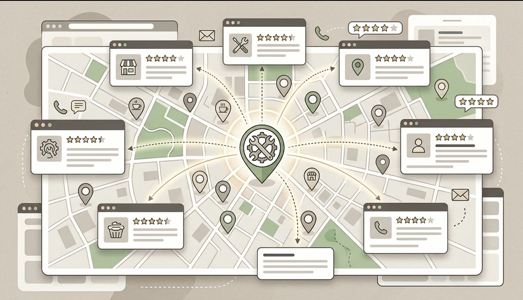
Professional and home-service businesses improve AI visibility by maintaining accurate Google Business Profiles, earning authentic reviews, creating location-specific content, using local schema markup, and building topical authority around their service areas and specialties. These five actions give AI systems the structured signals they need to include a business in local recommendations, map results, and AI-generated answer summaries.
How AI Systems Handle Local Queries
Local search has always operated on three factors: proximity (how close the business is to the searcher), prominence (how well-known and reputable the business is), and relevance (how well the business matches the query intent). AI systems apply these same three factors but evaluate them across a broader range of data sources and platforms.
Google's AI Overviews, introduced at scale in 2024 and refined through 2025, now frequently include local business recommendations drawn from the Google Business Profile network and the Knowledge Graph. When a user searches for "emergency plumber near me" or "best accounting firm in Budapest," the AI Overview may display a Local Pack directly within the generated response.
ChatGPT handles local recommendations differently. Without real-time access to Google's local index, ChatGPT relies on training data that includes review site content, directory listings, published articles, and business websites. Businesses mentioned frequently in local contexts or listed with consistent information across the web are more likely to appear in ChatGPT's recommendations.
Bing's AI-powered search pulls from Bing's own local index and Microsoft Maps data. In February 2026, Microsoft introduced AI Performance in Bing Webmaster Tools, giving publishers visibility into how their content performs in AI-generated responses for local queries.
The practical implication: local businesses must now optimize for multiple AI systems simultaneously. Consistent, structured, and authoritative signals across platforms are what earn AI recommendations.
Google Business Profile Optimization
Google Business Profile remains the single most important asset for local AI visibility. AI Overviews, Google Maps, and the Local Pack all draw heavily from GBP data. A complete and actively managed profile sends strong relevance and prominence signals.
Complete Every Field
Businesses should fill out every available field in their GBP: business name, address, phone, website, hours, services, products, attributes, and business description. Incomplete profiles rank lower because AI systems interpret missing data as lower confidence. A plumbing business that lists specific services — drain cleaning, pipe repair, water heater installation — gives AI systems more matching opportunities than one that simply lists "plumber."
Choose Precise Categories
Primary and secondary categories directly influence which queries trigger a business's appearance. Select the most specific primary category available and add relevant secondary categories. An automotive repair shop specializing in Volkswagen servicing should use "Auto Repair Shop" as primary and add precision categories where available.
Photos, Posts, and Q&A
Fresh photos signal an active business. GBP posts (weekly or biweekly) keep the profile current and provide keyword context. The Q&A section should be monitored and answered proactively — these questions and answers are visible in search results and can appear in AI-generated summaries. A well-maintained Q&A section also reduces the chance of incorrect information being displayed.
Local Content Strategy
Service businesses often make the mistake of creating generic service pages and hoping local signals carry the rest. AI systems need explicit local context. A well-structured local content strategy connects a business's expertise to specific places, problems, and customer situations.
Service Area Pages
Each primary service area should have its own dedicated page with unique content — not duplicate pages with swapped city names. Include area-specific details: neighborhoods served, local landmarks, travel directions, parking information, and area-specific service notes. An accountant in Budapest might create pages for the 13th district and 2nd district, noting proximity to local business hubs and district-specific tax considerations.
Neighborhood Content and Local Case Studies
Beyond service area pages, publish content that demonstrates local expertise: neighborhood guides, partnership announcements, community involvement, and location-specific case studies. A home-service business that publishes a kitchen renovation case study for a specific Budapest neighborhood gives AI systems a verifiable local signal that generic content cannot match.
The Local Content Checklist
The following eight-point checklist provides a practical framework for building local content that AI systems can parse and rank:
Review Strategy for Local AI Visibility
Reviews are a prominence signal that AI systems weigh heavily. Google's AI Overviews often cite review counts and ratings directly. ChatGPT's training data includes review content from major platforms. A structured review strategy is therefore an essential component of local AI visibility.
Authentic Google Reviews
Quantity and quality of Google Reviews directly influence Local Pack ranking and AI Overview inclusion. Businesses should request reviews from satisfied customers after every completed service. The request should be simple, direct, and sent at the moment of highest customer satisfaction. Offering incentives for reviews violates Google's policies and can result in review removal.
Response Strategy
Responding to every review (positive and negative) demonstrates active business management. Responses should be personalized, mention the service provided, and include natural references to location or specialty where appropriate. These responses are public, indexable, and can appear in AI-generated summaries. A well-crafted response to a negative review can neutralize its impact and demonstrate professionalism to prospective customers.
Review Sentiment as an AI Signal
AI systems analyze sentiment patterns across reviews, not just average star ratings. A business with a 4.6-star rating and consistently positive sentiment about specific services ("fast response," "fair pricing," "excellent workmanship") may rank higher than a 4.8-star business with vague or mixed sentiment. Encouraging customers to mention specific services or outcomes provides richer data for AI systems.
Local Schema Markup
Schema markup is machine-readable code that tells AI systems exactly what a page contains. For local businesses, specific schema types are essential for visibility in AI-generated responses.
LocalBusiness Schema
The LocalBusiness schema type identifies a business's name, address, phone number, hours, and geographic coordinates. Every local business should implement this on its homepage and contact page. The GeoCoordinates property is particularly important — it gives AI systems precise location data for proximity calculations.
Service Schema
The Service schema type allows businesses to mark up individual services with names, descriptions, and pricing. A home-service business can use Service schema on each service page, connecting it to the parent LocalBusiness entity. This helps AI systems match services to specific queries.
FAQ Schema for Service Pages
Adding FAQPage schema makes content eligible for rich results and gives AI systems structured question-answer pairs. A well-structured FAQ page is one of the most reliable ways to appear in AI-generated answers for service-related queries. In 2025, Google adjusted how FAQ rich results are displayed, but the schema data remains valuable for AI processing.
Google's AI features in Search documentation provides guidance on structured data that helps content surface in AI Overviews.
Service Business Case Studies
The following examples illustrate how two different service businesses have improved their local AI visibility through targeted strategies.
▶ Evidence
Auto-Szerviz 14 is a Budapest-based automotive repair shop that improved its local search presence by implementing transparent pricing pages, detailed service descriptions, and consistent GBP management. Clear price lists for common services — oil changes, brake replacement, timing belt service — capture high-intent local searches. This transparency earns mentions in AI-generated responses because specific data points match query patterns for cost-related automotive searches. Active review management and LocalBusiness schema markup strengthen visibility across Google's Local Pack and map results.
▶ Evidence
Centrum Audit, an accounting and tax advisory firm, improved its AI visibility by creating service pages organized around specific business needs — tax preparation, payroll, company formation — each connected to Hungarian regulatory context. Authoritative content addressing local compliance questions, combined with proper schema markup, signals both relevance and expertise to AI systems processing business service queries. Consistent NAP (name, address, phone) data across directories and an active GBP presence reinforce prominence signals for accounting-related local searches.
Both cases share a common pattern: clear service definitions, location-aware content, structured data, and consistent profile management. These are foundational elements AI systems need to recommend a local business.
▶ Key Insight
Local AI visibility depends on the same three factors as traditional local SEO — proximity, prominence, and relevance — but measured across AI platforms rather than a single search engine. A business that ranks well in Google's Local Pack may still be invisible to ChatGPT or Bing Copilot if its signals are not distributed across the web in structured, mentionable formats.
Frequently Asked Questions
Sources
1. Google Developers. "AI features in Search." https://developers.google.com/search/docs/appearance/ai-features. Accessed June 2025.
2. Bing Webmaster Blog. "Introducing AI Performance in Bing Webmaster Tools — Public Preview." February 2026. https://blogs.bing.com/webmaster/February-2026/Introducing-AI-Performance-in-Bing-Webmaster-Tools-Public-Preview.
3. Auto-Szerviz 14. Automotive service business website. https://auto-szerviz14.hu/.
4. Centrum Audit. Accounting and tax advisory services. https://centrumaudit.hu/.
Want your service business to appear in AI-generated local recommendations?